 Art-Worlds
 Cresap Mound, West Virginia and "Mounds for the Dead"
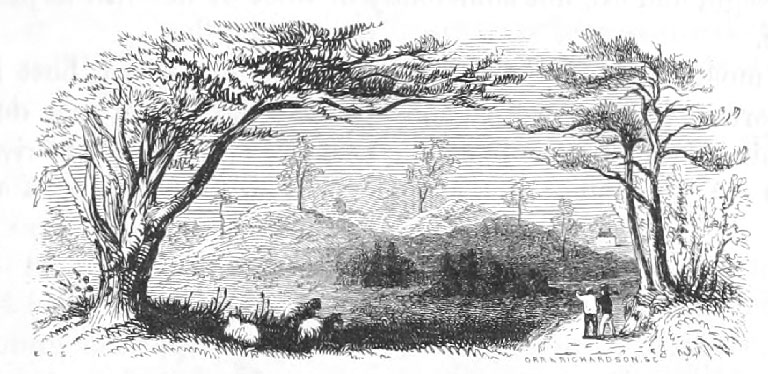
After researching the Grave Creek mound and its amateur excavation and later commercialization, I thought a comparison with another Adena mound would be helpful. There are many Adena mounds, such as Beech Bottom, Natrium, Half Moon, and Welcome Mound, in the upper Ohio River valley. The Cresap site was 6.5 miles south of the Grave Creek mound. It was located 1090 feet from the Ohio River on land once claimed by George Washington, then later owned by the Cresap family, and finally by the Hannah Coal Company. Two slightly smaller mounds were nearby; these had been tampered with and were not part of the excavation. Delf Norona learned of changes that would impact the site and contacted the West Virginia Archeological Society, Carnegie Mellon, among others, which led to the excavation of the mound. Mounds for the Dead by Don Dragoo gives a detailed account of the excavation and site report. Cresap Mound was destroyed during the process.
Cresap mound dimensions were 15 feet high, 70 feet in diameter, possibly eroded from 17 feet by 60 feet. It was a conical mound. The burials ranged from 13.5 feet above ground level to sub-mound burials 3.8 feet below. At least 54 individuals' remains were found. They found 4 children, 16 adult males, and 3 adult females. The skeletal remains varied; scattered bone fragments suggested that more people may have been interred there. One male in the subfloor burials was large, estimated to be 7.2 feet tall. The better-preserved skeletons showed Adena traits.
Red ochre was found in 23 features. The postholes and organic material found around the edges suggest that the mound was built over a house. Some of the grave goods included: leaf-shaped blades, celts, drills, scrapers, pipes, and tablets. These tablets were flat stones, some with ridges on one side, thought to be used to grind color or as stamps to decorate the body. Body ornaments like an elk head-dress, gorgets, and shell beads were found. Did the selection of items have to do with what or who the person might meet in the afterlife?
The Adena
Reading Mounds for the Dead helped me understand the origins of the Adena culture. At first, some archaeologists proposed that the Adena originated in Central America based on their rounded skulls and mound-building culture. Dragoo thought that archaic cultures closer to Ohio were the origins: the Red Ochre Culture and the Glacial Kame Culture.
The Red Ochre Culture
The Red Ochre culture was centered in Illinois but was also found in Indiana, Michigan, Wisconsin, and Ohio. They had complex burials in shallow pits on natural ridges and made their own low mounds. This progression shows a transition toward the creation of man-made mounds. As the name suggests, the burials included the practice of sprinkling red ocher over caches of artifacts.
The Glacial Kame Culture
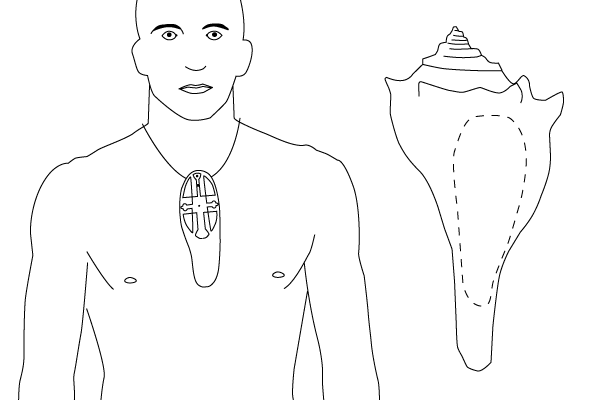
The Glacial Kame Culture was found in northwestern Ohio, northeastern Indiana, southern Michigan, and southern Ontario. The burials were found in moundlike hills of drift, deposited by glaciers, mostly gravel, which helped preserve the bodies. The burial artifacts include gorgets that look like modern shoe insoles made from conch shells of the Busycon genus from the Gulf of Mexico. Columella shells, bead disks, and copper were found. It is often noted that the later Ohio Hopewell Culture (100 BCE to 500 CE) had access to exotic materials, such as shells and copper. These finds show that shells and copper were already in the Midwest at a very early date.
The book also discusses the Adena physical type and how it differed from that of the Hopewell people. The book warns us that we don't have a complete picture of all the Adena, but some were very tall and powerfully built, as shown by the bodies found at Cresap and Criel. Adena traits included head deformation, large faces with prominent chins, and pronounced cheekbones. They also had rounded craniums, and their skull domes were higher than those of most humans. Researchers are unsure whether the head deformation was caused by natural selection, head binding, or the use of cradle boards. The Hopewell Culture overlaps the late Adena and continues after it. The Hopewell are thought to have had totally different origins, with narrower skulls and lighter bodies. The burial pattern shows that the Hopewell displaced the Adena in central Ohio, especially in the Scioto Valley.
The excavation took place in 1958, and Mounds for the Dead was published in 1963. I looked around for more modern papers on the Adena. These question some of the early assumptions, such as the idea that the mounds were built to honor male heroes and that ordinary people were cremated and buried in fields. Also, the Adena became a more hierarchical culture, enabling them to plan and construct the extensive earthworks and grow more crops to support a workforce to build them. Bodies were buried in subflooring chambers in houses, which were then burned down and formed the base layer of the mounds.
Later Research
Scholars have questioned whether the term “Adena” should be applied to societies outside Ohio and the Ohio River Valley. New research has been done on rings of postholes and double postholes, once thought to be houses. Now they are considered ceremonial spaces that might have been screened by a palisade-like fence with no roofs, used for ceremonies and processing the dead. The researchers don't see evidence of increased farming. The Adena grew crops like squash, sunflowers, and weedy annuals like goosefoot, knotweed, and maygrass. There is no evidence of growing corn, which often signals a change in society. Since the majority of mounds were built over many years or centuries, there wasn't a need for a hierarchical society. Most of the Adena mounds are roughly the size of Cresap, not large like the the Mammoth Mound at Grave Creek. Ceremonial complexes may have served other purposes, such as gathering places or trading centers. See links below for more information.
References
- Clay, R. Berle (1998) The Essential Features of Adena Ritual and their Implications. Published by: Taylor & Francis, Ltd. on behalf of the Southeastern Archaeological Conference. PDF avaiable at Jstor.org
- Dragoo, Don W. (1963) Mounds for the Dead (Annals of Carnegie Museum, Vol. 37) The Carnegie Museum of Natural History Pittsburg, PA. Read online at Archive.org
- Hays, C. T. (2010). Adena Mortuary Patterns in Central Ohio A Southeastern Archaeology, 29(1). PDF avaiable at Jstor.org
- Keller, Christine K. (2009) Glacial Kame Sandal-sole Shell Gorgets: an Exploration of Manufacture, Use, Distribution, and Public Exhibition. Ball State University Muncie, Indinana. PDF available Cardinalscholar.bsu.edu
- Norona, Delf (1954) Moundsville's Mammoth Mound (ISBN 0929915348, 9780929915340), West Virginia Archeological Society, 1962. Public Domain copy available babel.hathitrust.org
- Purtill, Matthew P. (2014) Open-Air “Adena” Paired-Post Ritual Features in the Middle Ohio Valley: A New Interpretation Midcontinental Journal of Archaeology, Vol. 39 No. 1, Winter, 2014, 59-82. PDF avaiable at www.Academia.edu
- Squier, E.G and Davis, E.H. (1988) Ancient Monuments of the Mississippi Valley
(Paperback Edition: 978-1-56098-725-3) Smithsonian Books; 150th anniversary ed edition (October 17, 1998)
Available as a PDF at the U.S. Library of Congress Website.