 Art-Worlds
 The Grave Creek, Mammoth Mound, Moundsville WV
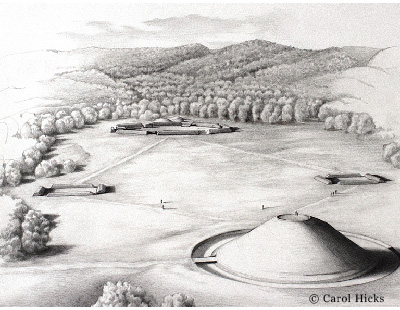
Site: Grave Creek or Mammoth Mound
Location: 801 Jefferson Ave, Moundsville, WV 26041
Google Maps Link
Date of visit: August 2025
Moundsville is located on the Ohio River in the sliver of West Virginia that sits between Ohio and Pennsylvania. It is part of the Appalachian Plateau, about 1,200 feet above sea level. The Ohio River here is narrow, creating broad meander-like curves in the landscape. Cliff walls can go from the river's edge to 400 or 500 feet. It is a rugged forested country. Moundsville is located at an elbow in the river, with flats on both sides. Seth Eastman's 1845 map shows the big mound, other smaller ones, and also shows the locations of round, stone-well-like watch towers on the hills on both sides of the river. We drove into Moundsville on Route 2, going north. Now I wish I had paid more attention to Cresap, a small community we passed right before seeing Moundsville.
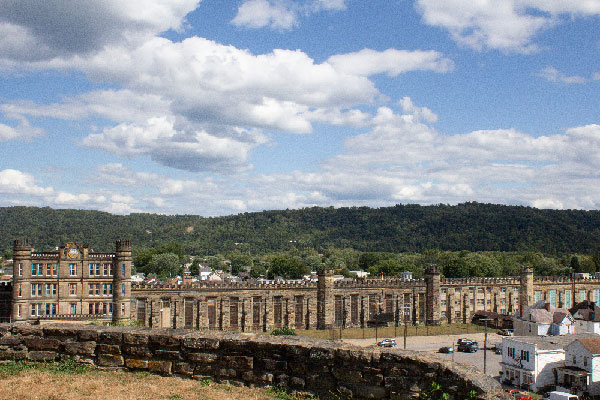
Before visiting, I had read in The Illustrated Encyclopedia of Native American Indian Mounds and Earthworks by Dr. Greg Little that the Grave Creek Mound site once contained an octagon similar to the one found in Newark, Ohio. Once there, I bought Delf Norona's Moundsville's Mammoth Mound booklet in the museum gift shop. On page 13 was a diagram showing General Richard Butler's description of the other earthworks near the mound. It was a helpful reference, and I used it as the basis for my drawing of the mound. However, I was not prepared to see the old West Virginia Penitentiary across the street from the mound. The penitentiary may be more of an exciting attraction for tourists than the mound. Out of curiosity, I picked up a brochure. It has daily historical tours from April through November, paranormal events, and escape room games.
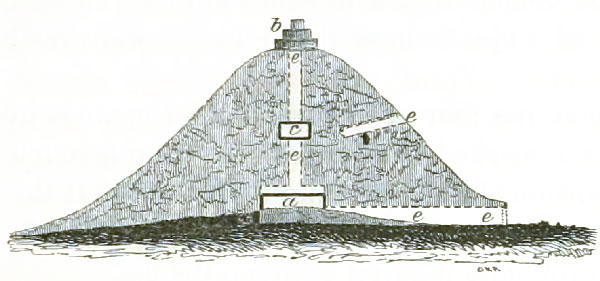
Mammoth Mound is the largest Adena mound (larger than the Criel mound in West Virginia and the Miamisburg mound in Ohio) at 69 feet tall with a 295-foot diameter. It has a conical shape and was built on a naturally occurring ridge. Once it also had a 40-foot-wide, 5-foot-deep moat, with a causeway pointing south to the Ohio River. Like most Adena mounds, it was built in stages. The settlers discovered it before the American Revolution. The local indigenous people at that time had very little knowledge of the mound, but they said a great battle had been fought there. There were anywhere from 30 to 100 smaller mounds in the area. Other artifacts were plentiful, and certain parts of the countryside in the area were considered Indian fields. The first excavation was undertaken in 1838 by the owner and other amateurs. The dig started at ground level, and then they sank a shaft from the top to the center. They also tunneled on one side, and they poked holes in it with tools used for digging wells. They found two vaults. Later, a wood-lined passageway was discovered. We don't know if this was used to visit the dead for rituals or to see them lying in state.
The Lower Vault
The lower vault was located in the subfloor and was approximately 8 x 12 feet. Logs might have supported the sides of the grave over which other logs were placed, with a roof of river stones 2.5 feet deep. Two remains were found, a man and a woman, with heads together-the woman pointed east and the man west. The woman had unusual molars called “double teeth” that were worn down, leading to the idea that she was elderly at the time of her death. The man's burial contained 650 beads, which at first were thought to be made of ivory, then disk-shaped shell beads; an expanded center-bar gorget, which might have been used to balance a spear-throwing device called an atlatl.
The Top Vault
The upper vault was about halfway up the mound. The tomb has been described as a wooden, cradle-like structure in an 8 x 18-foot space. This might have been a factor in the mound's final size. It contained one male skeleton with many more artifacts. A display in the museum shows a drawing of the finds: 1,700 disk-shell beads, 500 Marginella shell beads, one expanded-center-bar gorget, one diamond-shaped gorget is shown close to the head, five copper bracelets worn on both arms, and 240 mica fragments, some of which had been perforated. It was thought these were sewn together to form a shoulder dress or a warrior scarf. The placement on the graphic shows them below the waist; could they have been attached to a kilt?
The mound is considered late Adena. I didn't find reliable dating. We aren't sure if the Adena were influenced by the Hopewell or vice versa. The cultures overlapped. To me, this site is a Hopewell/Adena hybrid, as shown by the octagon and the use of mica for ornamentation, both traits associated with the Hopewell culture. The lower-vault burial fits better with the Adena culture. If, as later Indigenous people reported, it was the scene of a great battle, maybe features like the octagon were used to help the dead with a rite such as the passage of souls. Eventually, they cored the center of the mound to create a staircase and built a museum by expanding the bottom vault, and at that time, they found more seated remains. Then, a light three-story pavilion was added to top it all off. A total of 13 remains were found. One more recent burial was found near the top of the mound.
The most controversial find was the Grave Creek Tablet—a small grayish sandstone oval measuring 1.5 by 2 inches. Incised in the stone were marks that might have been runes. The Adena culture did have objects that are called tablets. These were thought to be used to grind paint or as stamps for body decoration. This tablet is now considered a hoax, created to promote the museum. Several translations were attempted, but what is interesting is that it ended up in the hands of Ephraim Squier and Edwin Davis, who sold it to a collector in England. The authors included the Grave Creek Mound in the Smithsonian's Ancient Monuments of the Mississippi Valley, with an engraving showing the mound in a street scene, fenced in and with trees growing from it.
The Delf Norona Museum in Moundsville displays other finds from across West Virginia, including the Cresap Mound, located 6.5 miles south of Grave Creek Mound. This led me to read Mounds for the Dead by Don W. Dragoo. If you would like to learn more about the Adena people and the archaeological excavation of the Cresap mound, please see my blog post on the topic.
Links to more information
- The Grave Creek Mound Archaeological Complex wvculture.org
- The Moundbuilders' Art: A Confluence of 'Ingenuity, Industry, and Elegance' openvirtualworlds.org
- West Virginia Penitentiary in Moundsville, West Virginia Prison Tours wvpentours.com
References
- Little, Greg (2016) The Illustrated Encyclopedia of Native American Indian Mounds and Earthworks ISBN-10: 0940829584 ISBN-13: 978-0940829589. Eagle Wing Books, Inc.
- Norona, Delf (1954) Moundsville's Mammoth Mound (ISBN 0929915348, 9780929915340), West Virginia Archeological Society, 1962. Public Domain copy available babel.hathitrust.org
- Squier, E.G and Davis, E.H. (1988) Ancient Monuments of the Mississippi Valley
(Paperback Edition: 978-1-56098-725-3) Smithsonian Books; 150th anniversary ed edition (October 17, 1998).
Available as a PDF at the U.S. Library of Congress Website.