 Art-Worlds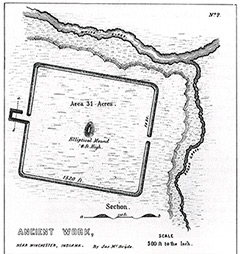
The Fudge Enclosure and the Path of Souls
The Site
The Fudge Works site is located south of the White River in Randolph County near Winchester, Indiana. It was a large rectangular enclosure with a smaller central elliptical mound. On Google Maps one sees only a shadow where the original enclosure existed. The first documentation of the site was an 1848 map by John McBride, which was included in Squier & Davis's Ancient Monuments of the Mississippi Valley. Reports describe walls that were six to ten feet tall and a central mound that was 100 feet in diameter and eight to fifteen feet tall. Later the site was used as fairgrounds, a gravel quarry, and farm fields.
Seltzer's Excavations
In 1929, Frank Seltzer excavated the central mound shortly before it was leveled by the landowner using a steam shovel. During the excavation, he found a burial pit containing a wooden structure with the remains of an adult male. Resting on the man's abdomen was another human skull, possibly a trophy skull. The burial was set on a layer of bark and then covered with about 20 feet of red ochre and bark. Both the body and the wooden structure were burned, with a large burned log placed above the pit. The area was enclosed by fencing, indicated by two sets of post holes. Two caches of votive offerings were also uncovered at the site.
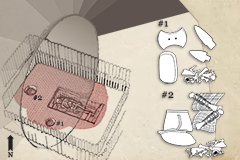
Cache# 1
- Cremated animal and bird bones
- Two large arrowheads, one a Cresap point
- Sandstone tablet, 4 or 5 inches
- Concave sided gorget
Cache# 2
- Surround by ocher and bark, cremated animal bones
- Two leather pouches with eight copper bracelets in each
- Pouches were lined with several layers of twined cloth
- The bracelets encircle strips of bark and human arm bones
The Path of Souls
Researchers believe that large geometric earthworks, such as the Fudge Enclosure, were used by the Hopewell-Adena people during afterlife ceremonies like the Path of Souls. The Andean culture dates from 500 BCE to 100 CE, while the Hopewell culture flourished from 200 BCE to 500 CE. The Hopewell people primarily lived in what is now Ohio, with related groups in Michigan, Wisconsin, Indiana, Illinois, Iowa, Kansas, Pennsylvania, and New York. Indiana, Illinois, Iowa, Kansas, Pennsylvania, and New York.
Part of their belief system was that humans had two souls. One soul gave life to the body and was associated with the skeletal system. The other, the "free-soul," would continue on in the afterlife. The bodies were prepared by removing the flesh from the bones. At the winter solstice, the bones were often burned, and the "free soul" could leap into Messier-42, known as the Orion Nebula, to gain access to the Milky Way, or the Path of Souls. Once on the Path of Souls, the "free-soul" was tested by the Adversary at the dark rift in the Milky Way. The Adversary could be symbolized as a raptor bird, an old woman, or a trickster. The results of this test was that the "free soul" could be returned to earth or reincarnated, go to the underworld, or journey to the realm of the ancestors.
These three illustrations show the constellation's alignments with the Fudge Enclosure on the winter solstice December 20, 21, 55 CE and how the site could have been used in the Path of Souls ceremony.
Orion Rises
Cygnus Sets
Orion Sets
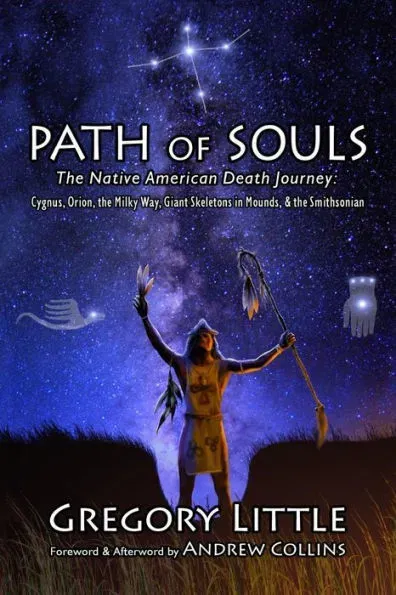
Dr. Gregory Little's book, Path of Souls, The Native American Death Journey, explores the research into the Southeastern Ceremonial Complex or Southern Death Cult that fits the astronomical alignments found at the Fudge Site. The book goes into much more detail and explains the symbolism behind many artifacts. The author also delves into reports about large skeletons and giants in pre-Columbian America. Were these giants part of a ruling elite? The book includes a foreword and afterword by Andrew Collins, an author who has investigated prehistory sites from the Giza plateau to Göbekli Tepe.
Links to more information
Indiana's Largest Hopewell Earthwork Was Utilized in the Path of Souls Rituals: Stellar Alignments at the Winchester, Indiana Ancient Earthworks by Dr. Greg Little | AP Magazine website
Youtube - Path of Souls Dr. Greg Little
The Fudge Site: A New Look at an Ancient Monument, Randolph County, Indiana authors: Beth McCord, and Donald R. Cochran | Ball State University website